精华热点
精华热点 
文/王海安
前不久,因为办案到陕西省安康市白河县待了几天,对白河又有了新发现。虽然过去也到过白河,但这次因为时间稍长,对这个秦头楚尾的山城有了更进一步的了解。
Not long ago, I spent several days in Baihe County, Ankang, Shaanxi, handling casework, and made new discoveries about this place. Though I had visited Baihe before, the extended stay this time allowed me to gain a far deeper insight into this mountain city known as the junction of ancient Qin and Chu territories.
白河地处陕西东南部,南依巴山,北临汉江,东、南、北三面分别与湖北省十堰市的郧阳区、竹山县和郧西县相邻,西面与陕西省的旬阳市接壤。
Geographically, Baihe sits in southeastern Shaanxi, bordered by the Bashan Mountains to the south and the Hanjiang River to the north. To its east, south and north lie Yunyang District, Zhushan County and Yunxi County of Shiyan City, Hubei Province, while Xunyang City of Shaanxi adjoins its western flank.
春秋时期,白河地区属麇国,称钖。战国,本境先属楚,后归秦,秦设钖县,属汉中郡(治所在今汉中市)。东汉末,建安二十四年(公元219年),钖县改属西城郡(治所在今安康市)。三国,曹魏黄初二年(公元221年),西城郡改称魏兴郡,仍隶钖县;太和二年(公元228年),于钖县兼设钖郡,景初元年(公元237年)废。
The county boasts a long, layered history. During the Spring and Autumn Period, the area belonged to the State of Mi and was named Yang. In the Warring States Period, it first fell under Chu rule before being annexed by Qin, which established Yang County under the Hanzhong Commandery (seat in present-day Hanzhong). At the end of the Eastern Han Dynasty, in the 24th year of Jian’an (219 AD), Yang County was transferred to Xicheng Commandery (seat in present-day Ankang). Under the Three Kingdoms, the Wei renamed Xicheng Commandery Weixing Commandery in the 2nd year of Huangchu (221 AD), still governing Yang County. A separate Yang Commandery was set up within Yang County in the 2nd year of Taihe (228 AD), only to be abolished in the 1st year of Jingchu (237 AD).
南北朝时期,南朝梁废钖县,于本境南设阳川县、北设熊川县。西魏文帝大统元年(公元535年),在本境东南设丰利县;西魏废。帝元年(公元552年),在丰利县设丰利郡,领丰利、熊川、阳川3县。北周武成二年(公元560年),废丰利郡,丰利县改属上津郡(治所在今湖北郧西县),同时废熊川、阳川2县,辖地并入丰利县。
In the Southern and Northern Dynasties, the Liang Dynasty scrapped Yang County, founding Yangchuan County in the southern part of the territory and Xiongchuan County in the north. In the 1st year of Datong under Emperor Wen of Western Wei (535 AD), Fengli County was built in the southeast. The 1st year of Emperor Fei’s reign (552 AD) saw the creation of Fengli Prefecture based in Fengli County, administering three subordinate counties: Fengli, Xiongchuan and Yangchuan. In the 2nd year of Wucheng under Northern Zhou (560 AD), Fengli Prefecture was dissolved, and Fengli County came under Shangjin Commandery (seat in present-day Yunxi County, Hubei); Xiongchuan and Yangchuan Counties were abolished, their land incorporated into Fengli County.
隋大业三年(公元607年),复设西城郡,丰利县改属西城郡。唐贞观八年(公元634年),丰利县改属新设之均州。宋开宝元年(公元968年),废丰利县,辖地并入旬阳县,属金州(治所在今安康市)。元初,至元年间(公元1271~1294年),金州所辖之县皆废,本境为金州地,金州属兴元路(治所在今汉中市)。
The 3rd year of Daye in the Sui Dynasty (607 AD) reinstated Xicheng Commandery, to which Fengli County was reassigned. In the 8th year of Zhenguan in the Tang Dynasty (634 AD), Fengli County fell under the newly established Jun Prefecture. The 1st year of Kaibao in the Northern Song Dynasty (968 AD) abolished Fengli County, merging its territory into Xunyang County under Jin Prefecture (seat in present-day Ankang). In the early Yuan Dynasty, during the Zhiyuan reign (1271–1294 AD), all counties under Jin Prefecture were eliminated, leaving this land directly governed by Jin Prefecture, a subdivision of Xingyuan Circuit (seat in present-day Hanzhong).
明洪武三年(公元1370年),析金州东北部设旬阳县,属大宁州(治所在四川巫溪县),本境为旬阳县。明洪武五年(公元1372年),旬阳县改属金州;成化八年(公元1472年),于旬阳县东部置白河堡;成化十二年(公元1476年),以境内白石河名改设白河县,隶属新设之郧阳府(治所在今湖北郧县),次年改属金州;万历十一年(公元1583年),金州改称兴安州,隶白河县。
The 3rd year of Hongwu in the Ming Dynasty (1370 AD) split the northeastern territory of Jin Prefecture to establish Xunyang County under Daning Prefecture (seat in present-day Wuxi County, Sichuan), with our subject land falling within Xunyang’s bounds. Xunyang was transferred to Jin Prefecture in the 5th year of Hongwu (1372 AD). The 8th year of Chenghua (1472 AD) saw the construction of Baihe Fort in eastern Xunyang County. Twelve years later, in 1476, Baihe County was formally founded after the White Stone River running through the territory, placed under the newly created Yunyang Prefecture (seat in present-day Yun County, Hubei), then shifted to Jin Prefecture the following year. When Jin Prefecture was renamed Xing’an Prefecture in the 11th year of Wanli (1583 AD), Baihe remained under its jurisdiction.
清乾隆四十七年(公元1782年),兴安州升为兴安府,仍辖白河县。民国初,白河县属陕西省汉中道;民国二十二年(公元1933年),撤销道制,白河县属省辖;民国二十四年(公元1935年),为新设之第五行政督察区专员公署(驻今安康市)所辖。
In the Qing Dynasty, the 47th year of the Qianlong reign (1782 AD) elevated Xing’an Prefecture to Xing’an Circuit, which continued to administer Baihe County. In the early years of the Republic of China, Baihe belonged to Hanzhong Circuit of Shaanxi Province. The circuit administrative system was abolished in 1933 (the 22nd year of the Republic), placing Baihe directly under provincial governance. In 1935 (the 24th year of the Republic), it was incorporated into the newly founded Fifth Administrative Supervision District, whose commissioner’s office resided in present-day Ankang.
1949年中华人民共和国成立后,白河县隶属陕甘宁边区陕南行政公署安康分区行政督察公署管辖;1950年,隶属陕西省安康分区专员公署管辖,专员公署辖区又称专区,1969年改称地区,白河县隶属陕西省安康地区行政公署管辖至今。
After the founding of the People’s Republic of China in 1949, Baihe was administered by the Ankang Prefectural Administrative Supervision Office under the Southern Shaanxi Administrative Commissioner’s Office of the Shaanxi-Gansu-Ningxia Border Region. From 1950 onward, it fell under the Ankang Prefectural Commissioner’s Office of Shaanxi Province, whose jurisdiction was renamed Ankang Region in 1969, a governance structure that remains in place to this day.
我们了解到,清朝有一位白河籍文人陈瑺作了首《咏白河》的诗“一水分秦楚,清江入画楼,舟轻驰曲岸,帆正骋中流”,被传诵至今,还收入白河县志。
We learned that Chen Chang, a literati native to Baihe during the Qing Dynasty, penned a well-loved poem Ode to Baihe, which has been passed down through generations and recorded in the county annals:
One stream divides the realms of Qin and Chu,
Clear rivers wind past painted towers in view.
Light skiffs glide along winding river banks,
Full sails cut smoothly through midstream ranks.
现在的白河县,总面积1455平方公里,辖11镇122个行政村(社区),总人口21万。境内山陡谷狭,最高海拔1901米,最低170米(是全省最低点),760余条大小河流沟豁纵横,没有一块百亩以上的自然平地,25度以上的土石山区占总面积的95%以上,是国家乡村振兴重点帮扶县,南水北调中线工程水源涵养区。
Modern Baihe spans a total area of 1,455 square kilometers, encompassing 11 towns and 122 administrative villages and communities, with a permanent population of 210,000. Rugged mountains and narrow valleys define its terrain: the highest peak rises 1,901 meters above sea level, while its lowest point, merely 170 meters above sea level, marks the provincial minimum elevation. More than 760 streams and gullies crisscross the land; not a single natural flat plot exceeds 100 mu in size, and mountainous zones with slopes steeper than 25 degrees account for over 95% of its total territory. Classified as a key supported county for rural revitalization, Baihe also serves as a critical water conservation zone for the Middle Route of the South-to-North Water Diversion Project.
因为自然环境恶劣,一位主陕的领导干部为白河县总结了“领导苦抓,干部苦帮,群众苦干”的“三苦”精神,经过多年的对口支援、帮扶,白河县的面貌已发生了根本的变化。
Given its harsh natural conditions, a senior provincial leading cadre summarized Baihe’s pioneering ethos as the Threefold Perseverance Spirit: leaders forge ahead with relentless commitment, cadres offer wholehearted grassroots support, and residents strive tirelessly for a better life. Thanks to decades of paired assistance and targeted poverty alleviation, Baihe has undergone earth-shaking transformations.
譬如,白河县沿汉江岸本有一条长长的居民区,被当地人称为河街。河街自古便是“南走巫夔,北通商洛,东扼均房”的咽喉,商旅往来不绝,船工终日辛劳,造就了河街的繁华,被人称为“小汉口”。
Take River Street, a long residential strip hugging the Hanjiang embankment, as an example. Since ancient times, it stood as a vital thoroughfare: a gateway linking Wushan and Kuizhou to the south, Shangluo to the north, and Junzhou and Fangxian to the east. Merchants traveled back and forth year-round, boatmen labored from dawn till dusk, fueling the street’s prosperity and earning it the moniker “Little Hankou.”
然而自上世纪70年代以降,因丹江水库蓄水断航,石泉水电建设阻渡,兼之襄渝铁路与316国道分流商脉,更有“十年九淹”的水患,河街渐呈颓势,其因水而兴、因水而贫,旧有的繁华一去不返,成为远近闻名的棚户区。当地政府以10年时间对河街棚户区进行改造,已使其旧貌焕新颜。如今的河街,一栋栋高楼临江而起,道路宽阔平坦,成为推窗见景的生态家园。现代化的高速公路、铁路,将白河县与外界紧密联系在一起,商贸交流密切,特产成为市场的抢手货。此地姑娘手巧,制作的钖绣远近闻名,成为响当当的非物质文化遗产。
From the 1970s onward, however, River Street fell into decline. The Danjiang Reservoir impoundment halted river shipping; the Shiquan Hydropower Station blocked ferry crossings; the Xiangyu Railway and National Highway 316 diverted commercial traffic; and annual catastrophic floods left the area perpetually waterlogged. Flourishing thanks to water, it was also impoverished by water, its former bustle fading into memory as it devolved into a sprawling shantytown. Local authorities carried out a decade-long renovation project to revitalize River Street, utterly transforming its landscape. Today, rows of high-rise residential buildings line the riverfront, wide smooth roads stretch far, and the district has evolved into an eco-friendly riverside home where every window frames stunning waterscape views. Modern expressways and railways tightly connect Baihe to the outside world, boosting vibrant trade and turning local specialties into sought-after market goods. The county’s women boast exceptional embroidery skills, crafting Yang Embroidery—a renowned intangible cultural heritage unique to Baihe, named after the ancient Yang County.
老县城的桥儿沟,是明清的商贸古街,现在成了文旅融合的网红打卡地,沟里的老字号商铺、宅院等处,家规家训遍布其间,泉眼密集,水质清冽,游兴至处,随便掬一口,只觉五脏六腑通透舒爽,直呼美美美,撩咋咧!
Bridge Ditch, an ancient commercial thoroughfare dating back to the Ming and Qing dynasties in the old county seat, has now become a viral cultural tourism destination. Traditional shops and courtyard residences lining the ditch display ancestral family precepts on every wall, while dense natural springs gush crystal-clear fresh water everywhere. Visitors often scoop up handfuls of spring water to sip, instantly feeling refreshed from head to toe and exclaiming in local Shaanxi dialect: “Marvelous! Simply fantastic!”
白河县还有一个奇特的文化现象,就是复姓人家多:令狐、上官、公孙、欧阳、东方、皇甫、南宫……,哇,是不是很奇妙?
Baihe is also home to a fascinating cultural quirk: an unusually high concentration of compound surnames, including Linghu, Shangguan, Gongsun, Ouyang, Dongfang, Huangfu and Nangong—truly a remarkable sight to behold.
在白河,适逢芒种,当地有关部门陪我们观景、夜游桥儿沟,感触颇深,陕西云达律师事务所律师薛瑞祥成诗一首:
I visited Baihe around the Grain-in-Ear solar term, and local officials accompanied me on sightseeing tours and a nighttime stroll through Bridge Ditch, leaving me profoundly moved. Xue Ruixiang, attorney from Shaanxi Yunda Law Firm, composed an impromptu poem on the spot:
汉江晓起
天欲破晓碧如黛,
流岚绕岫雾半开。
潋滟江波浮翡翠,
参差林樾啭雉彩。
尘心顿作烟霞散,
清梦直随鸥鹭来。
便欲抛书从此去,
一蓑烟雨向苍崖。
Before daybreak, the river shimmers dark indigo,
Mist coils round peaks, half-lifting its veil slow.
Glittering ripples bear jade-green light,
Woods tiered on hills ring with pheasant song bright.
All mortal cares dissolve into mist and cloud,
Pure dreams drift forth with gulls floating proud.
I long to lay down my books and depart this shore,
Roaming misty crags with a straw raincoat and oar.
众人看薛瑞祥律师出口成章,转身盯住我问:你呢?啊哈哈,盛情难却,也来一首吧:
Witnessing Attorney Xue’s effortless verse, the group turned to me, urging I write one too. Unable to decline their warm invitation, I composed my own poem:
波光潋滟晴方好,
画栋雕梁鸣翠鸟。
推窗极目汉江云,
抬首尽览孤山晓。
算黄算割催农时,
修性修心敬耆老。
夜伴清风游古巷,
桥儿沟里泉如趵。
Rippling waves glow bright beneath clear skies,
Carved beams and painted eaves resound with birds’ cries.
I fling wide windows to gaze on Hanjiang clouds,
Lift my head to behold lone mountains at dawn’s crowds.
Cuckoos cry “Harvest the ripe wheat” to urge farm toil,
We nurture virtue and respect the elderly with loyal toil.
By night, I wander the ancient lane with cool wind at my side,
Where springs bubble forth in endless streams through Bridge Ditch wide.
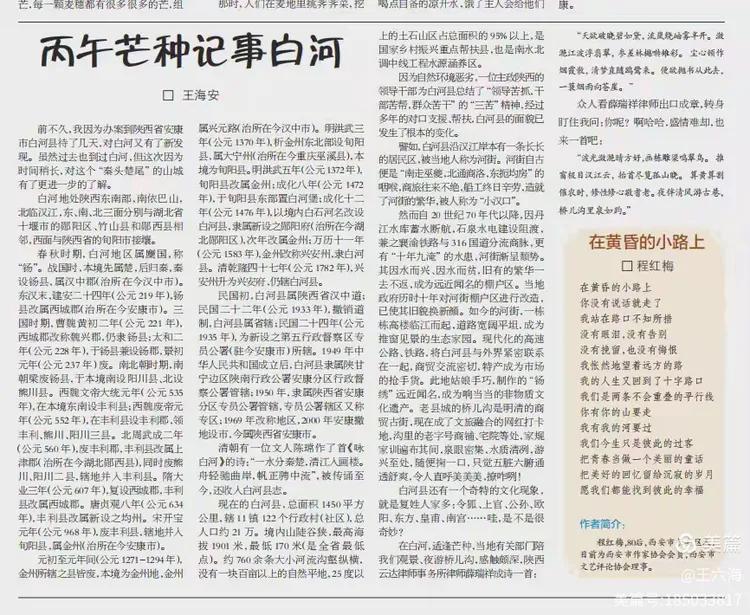
文章被陕西广播电视报刊发
This article was published in Shaanxi Radio and Television News
编辑:王三周
Editor: Wang Sanzhou