精华热点
精华热点 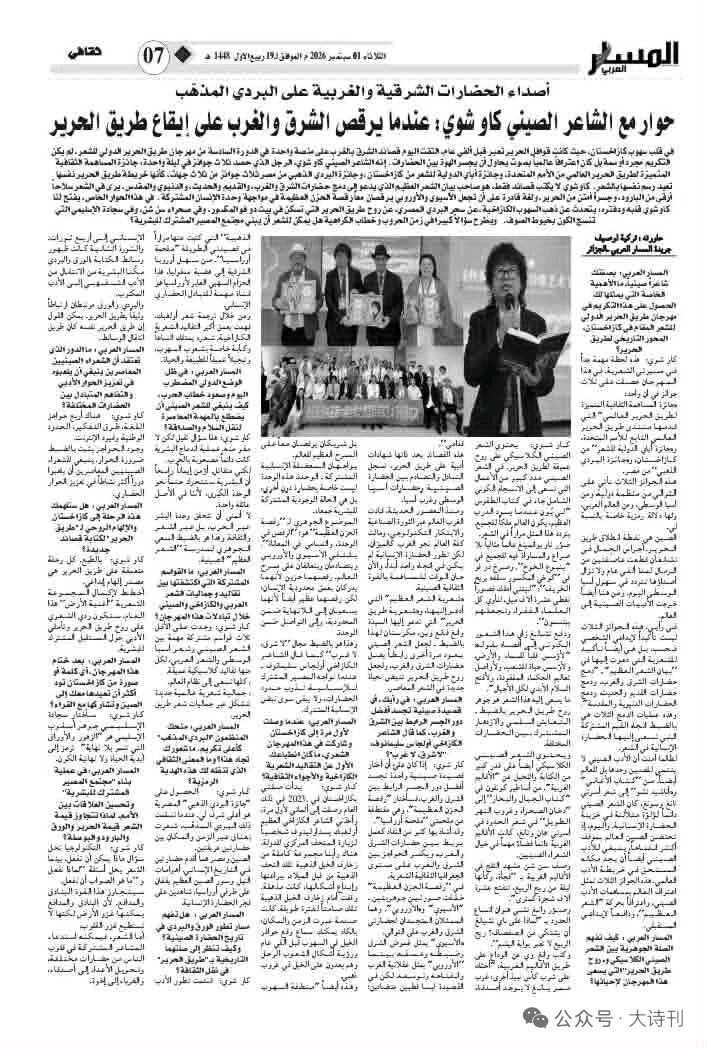
大诗主义运动合一天人 融合古今 合璧东西随物赋形 和合阴阳 整合音义人类同源 世界大同Great Poetry MovementIntegration of Sacred and Secular CulturesIntegration of Western and Eastern CulturesIntegration of Ancient and Modern Cultures鎏金纸莎草上的东西方文明回响——中国诗人曹谁在第六届丝绸之路国际诗歌节深度访谈阿尔及利亚《阿拉伯道路报》2026 年 9 月 1 日第 07 版文化版【编者按】第六届丝绸之路国际诗歌节在哈萨克斯坦隆重举行。中国著名诗人、作家,大诗主义倡导者曹谁应邀出席,并一举斩获三项国际大奖:联合国世界丝路论坛"世界丝绸之路杰出文化贡献奖"、哈萨克斯坦"阿拜国际诗歌奖"、埃及"金莎草纸奖"。本届诗歌节汇聚了来自中国、哈萨克斯坦、乌兹别克斯坦、吉尔吉斯斯坦、埃及等多国诗人,以诗歌为桥梁,续写丝绸之路的文明对话。本报记者对曹谁进行了独家深度访谈。
一、在丝绸之路的历史枢纽获奖:中国文学从这里走向世界记者:作为一位中国诗人,在丝绸之路历史枢纽——哈萨克斯坦举办的"丝绸之路"国际诗歌节上获此殊荣,对您而言有何特殊意义?曹谁:这是我诗歌生涯中极为重要的时刻。在本届诗歌节上,我同时获得了三个奖项——联合国世界丝路论坛颁发的"世界丝绸之路杰出文化贡献奖"、哈萨克斯坦的"阿拜国际诗歌奖",以及埃及的"金莎草纸奖"。这三个奖项分别来自国际组织、中亚和阿拉伯世界,对我而言具有特殊的象征意义。中国是丝绸之路的起点,长安的驼铃声穿越两千年的风沙,至今仍在中亚的草原上回响。中国文学也正是从这里走向世界。在我看来,这三个奖项不仅是对我个人创作的肯定,更是对我在《大诗主义宣言》中所倡导的诗学理念的确认——"整合东方和西方文明,整合古代和现代文明,整合世俗和神圣文明"。这三种整合,正是人类文明追求的共同价值观在诗歌上的方向。我始终相信,中国文学不仅属于中国,更属于世界。从《诗经》《楚辞》到唐诗宋词,中国诗歌一直是人类文明宝库中的璀璨明珠。今天,当中国以更加开放的姿态拥抱世界时,中国文学也应当在世界文学的版图中找到自己应有的位置。这三个奖项,是世界对中国文学贡献的一次认可,对大诗主义诗潮的认可,也是对我未来创作的鞭策。二、中国古典诗歌与丝绸之路精神:天下大同的千年回响记者:您如何理解中国古典诗歌与本届诗歌节所致力于复兴的"丝绸之路"精神之间的内在联系?曹谁:中国古典诗歌中蕴含着深厚的丝绸之路精神。中国诗歌有大量追求"天下大同"的篇章。《礼记·礼运》中说"大道之行也,天下为公",这种理想在诗歌中反复回响。陶渊明在《桃花源记》中描绘了一个没有纷争、人人平等的理想世界;杜甫在《茅屋为秋风所破歌》中高呼"安得广厦千万间,大庇天下寒士俱欢颜";张载的"为天地立心,为生民立命,为往圣继绝学,为万世开太平",更是将这种天下情怀推向极致。这些诗歌所追求的,正是丝绸之路精神中最核心的部分——不同文明之间的和平共处与共同繁荣。中国古典诗歌中有大量对于西域的书写和想象。从《山海经》中的昆仑神话,到汉唐边塞诗中的大漠孤烟、长河落日,西域一直是中国诗人想象的重要空间。岑参的"忽如一夜春风来,千树万树梨花开",写的是西域的雪景;王之涣的"羌笛何须怨杨柳,春风不度玉门关",写的是边塞的苍茫;王维的"劝君更尽一杯酒,西出阳关无故人",写的是通往西域的离别。这些诗歌本身就是丝绸之路的文学见证,它们记录了中华文明与中亚、西亚文明之间的交流与碰撞。近代以来,西方通过工业革命和科技创新领先世界,世界的天平如同跷跷板一样向西方倾斜。但人类文明的发展从来不是单向的,如今正是贡献中国文化力量的时候。我倡导的大诗主义诗学,和王芳闻女士倡导的丝路诗学,正是致力于此——让中国诗歌重新成为连接东西方文明的纽带,让丝绸之路的精神在当代诗歌中获得新生。三、《大悲舞》:贯通东西方文明的诗歌桥梁记者:在您看来,哪一首中国诗歌最能体现贯通东西的桥梁作用,正如哈萨克诗人奥尔扎斯·苏莱曼诺夫所言"没有东方,没有西方"?曹谁:如果要选一首最能体现贯通东西的桥梁作用的中国诗歌,我会选择我自己《亚欧大陆地史诗》(Epic of Eurasia)中节选的诗《大悲舞》(Great Dance of Sorrow)。这首诗被不少评论家评为能够贯通东西方文明的作品,它从诗歌文化地理的层面打通了东方与西方。在《大悲舞》中,我塑造了两个核心意象——亚细亚人和欧罗巴人。他们分别是东西方文明的具象化代表。亚细亚人代表着东方的神秘、内敛与深邃,欧罗巴人代表着西方的理性、外向与扩张。但在诗中,他们并非对立的两极,而是在世界这个大舞台上共同舞蹈的伙伴。他们面临着人类共同的困境——孤独。这种孤独不是某一个文明独有的,而是全人类共同的生存处境。无论你来自东方还是西方,无论你信仰什么宗教、说什么语言,在浩瀚的宇宙面前,人类都是孤独的存在。《大悲舞》的核心主题是:在孤独中舞蹈,在痛苦中超越。亚细亚人和欧罗巴人在世界的舞台上相遇、碰撞、拥抱,他们的舞蹈是悲伤的,因为他们深知人类的有限性;但他们的舞蹈又是伟大的,因为他们在有限中追求无限,在孤独中寻找连接。这正是哈萨克诗人奥尔扎斯·苏莱曼诺夫所说的"没有东方,没有西方"的境界——当我们直面人类共同的命运时,文明的边界便消融了,剩下的只是人类共同的心跳。这首诗在多个国家被翻译和评论,有评论家说,《大悲舞》让他们看到了一种超越民族主义的世界诗歌的可能。我想,这正是诗歌的力量——它能让不同文明的人在同一个节奏中舞蹈,在同一种悲伤中相遇。四、初抵哈萨克斯坦:黄金草原上的文明震撼记者:您初抵哈萨克斯坦并参与本届诗歌节时,对哈萨克斯坦的诗歌传统与文化氛围有何第一印象?曹谁:我与哈萨克斯坦的缘分始于2023年。那一年我第一次抵达阿拉木图,哈萨克斯坦伟大的诗人乌鲁格贝克·耶斯道勒特亲自带我游览了中央国家博物馆。在那里,我们看到了全套的黄金马配饰——那些公元前的黄金器物,工艺之精湛、造型之华美,令人叹为观止。我站在那些黄金马饰面前,久久不能言语。那是一种穿越时空的震撼,你仿佛能听到两千年前草原上的马蹄声,能看到游牧民族在金色的夕阳下策马奔腾的身影。这也是我在长诗《亚欧大陆地史诗》中反复书写的"黄金草原"地带。从东欧平原到蒙古高原,这片横贯亚欧大陆的草原带,是人类文明交流的重要通道。斯基泰人、匈奴人、突厥人、蒙古人……一个个游牧民族在这片草原上崛起、迁徙、融合,他们不仅是战争的传播者,更是文明的传递者。那些黄金马饰,正是草原文明高度发达的物质见证。通过翻译乌鲁格贝克的诗歌,我对哈萨克斯坦的诗歌传统有了更深的理解。他的诗歌中有一种草原民族特有的辽阔与苍茫,有一种对自然和生命的深沉敬畏。在翻译过程中我深刻地体会到,人类有99.99%的共同情感,就像人类的基因有99.99%是相同的一样。爱与恨、欢乐与悲伤、希望与绝望,这些情感不分民族、不分语言。这让我更加相信我书中的主题——"人类同源,世界大同"。这次参加第六届丝绸之路国际诗歌节,我更加深入地了解了哈萨克斯坦以及乌兹别克斯坦、吉尔吉斯斯坦的文化。这些中亚国家虽然各自有独特的民族传统,但都共享着丝绸之路的文化基因。最近我写了一系列诗歌,试图深入融合丝绸之路的文明,把中亚的草原、沙漠、古城、传说都融入我的诗歌世界。五、战争话语抬头时:诗歌的和平使命记者:在当今国际局势动荡、战争话语抬头的背景下,中国诗歌应如何承担起传递和平与友谊的时代使命?曹谁:这是一个沉重但必须面对的问题。人类的融合过程,始终伴随着战争。从第一次世界大战到第二次世界大战,人类曾经付出了数千万生命的代价,也曾经短暂地吸取了教训。联合国的成立、国际法体系的建立、区域合作组织的发展,都是人类试图避免战争的努力。但令人痛心的是,如今地区战争重新抬头,战争话语又在一些国家甚嚣尘上。我对此深感忧虑。我担心第三次世界大战的爆发——在核武器时代,第三次世界大战将不再有胜利者,它会毁灭整个人类文明。人类的历史已经无数次证明,战争从来不是解决问题的最终方式,它只会带来仇恨的循环和文明的倒退。但我同时也是一个乐观主义者。我坚信人类必将走向大一统,因为我们原本就是一家人。从基因学的角度看,全人类都源自非洲的共同祖先;从文化学的角度看,各大文明之间从来都是相互交流、相互滋养的。丝绸之路本身就是人类和平交流的伟大见证——在这条漫长的道路上,商队带来的不是刀剑,而是丝绸、茶叶、瓷器和香料;僧侣传递的不是征服,而是佛法、经典和信仰。我不希望人类的统一通过战争来实现,而是希望通过诗歌和文化来实现。这正是中国大诗主义流派的核心追求。大诗主义倡导"整合东方和西方文明,整合古代和现代文明,整合世俗和神圣文明",这种整合不是通过武力,而是通过理解、对话和共鸣。诗歌是人类最古老的语言,也是最能跨越文明边界的语言。当一个中国诗人的诗歌被阿拉伯读者感动,当一个哈萨克诗人的诗句被中国读者传诵,文明之间的壁垒就消融了,和平的种子就播下了。中国诗歌应当在这个时代承担起传递和平与友谊的使命。我们要写出能够打动全人类的诗歌,要让世界听到中国诗人对和平的呼唤、对人类共同命运的思考。这不是一句空洞的口号,而是每一个中国诗人都应当践行的创作准则。六、阿拉伯、哈萨克与中国诗歌:三大传统的美学共鸣记者:在本次诗歌节的交流中,您在阿拉伯诗歌、哈萨克诗歌与中国诗歌的传统与美学之间,发现了哪些共通之处?曹谁:这次诗歌节的一个重要成果,是《丝路驼影》一书的出版。这本书由王芳闻主编,由我来翻译,其中收录了中国、哈萨克斯坦、乌兹别克斯坦、吉尔吉斯斯坦、埃及等多国诗人的作品。在翻译这些诗歌的过程中,我深刻地感受到了不同诗歌传统之间的共通之处。与此同时,埃及诗人阿什拉夫也翻译出版了我的长诗《亚欧大陆地史诗》阿拉伯语版本。我们一起在诗歌节上举行了首发式,之后又一起旅行、写作、研讨。在这个过程中,我对阿拉伯诗歌传统有了更深入的理解。我发现,中国诗歌、中亚诗歌和阿拉伯诗歌之间至少有三个重要的共通之处。第一,它们都有深厚的古典传统。中国有《诗经》《楚辞》和唐诗宋词,阿拉伯有悬诗和阿拔斯王朝的黄金时代诗歌,哈萨克有源远流长的口头史诗传统和阿肯弹唱。这些古典传统不仅是各自民族的文化瑰宝,也为当代诗歌创作提供了不竭的源泉。第二,它们都追求世界的秩序。无论是中国诗歌中的"道"、阿拉伯诗歌中的"伊斯兰"(意为顺从与和平),还是哈萨克诗歌中的"阿萨"(和谐与平衡),本质上都是对宇宙秩序和人类社会秩序的探寻。这种对秩序的追求,使得三大诗歌传统都具有一种超越性的维度——它们不只是写个人的情感,更是在书写人类对世界的理解和对理想生活的向往。第三,一种全新的世界诗歌美学,正在通过丝绸之路诗歌美学成形。在这次诗歌节上,我看到来自不同国家的诗人们在用各自的语言书写共同的主题——对丝绸之路的追忆、对文明交流的渴望、对人类和平的期盼。这些诗歌虽然语言不同、形式各异,但内在的美学追求是一致的。我相信,随着丝绸之路国际诗歌节等平台的持续推动,一种融合了东方与西方、传统与现代的全新诗歌美学正在诞生,而中国、中亚和阿拉伯诗歌将在其中扮演至关重要的角色。七、鎏金纸莎草:两个古老文明的诗歌拥抱记者:主办方以"鎏金纸莎草"作为最高荣誉授予您,您对此有何感想?这一象征性礼物向您传达了怎样的文化意涵?曹谁:获得埃及"金莎草纸奖",对我而言是最高的荣誉。这个奖项不仅是对我个人创作的认可,更是对我的长诗《亚欧大陆地史诗》阿拉伯语版本,以及我所倡导的大诗主义运动的认可。当我接过那张鎏金的纸莎草时,我感受到的是两个古老文明之间跨越时空的拥抱。中国和埃及,是人类历史上最古老的两大文明。尼罗河的金字塔和黄河的长城,分别矗立在亚欧大陆的两端,见证着人类文明的曙光。这两个文明虽然相隔万里,但都有着对永恒的追求、对秩序的思考、对生命的敬畏。纸莎草是古埃及文明的象征,正如丝绸是中华文明的象征一样——它们都是各自文明对人类文化传播做出的伟大贡献。通过这个奖项,两个古老的文明在诗歌中融合在了一起。获得这个奖项后,我更加深入地去了解埃及文明,以及与埃及文明密切相关的巴比伦、迦南、希腊、波斯、印度和中华文明。这些文明构成了人类古代文明的核心矩阵,它们之间的交流与融合,正是丝绸之路最深刻的历史意义。我为埃及的荷鲁斯神写了一首诗——《荷鲁斯的双眼》让月亮成为我的左眼让太阳成为我的右眼荷鲁斯望向哪里,哪里就会复活为父王奥西里斯复仇把他的所有尸块拼接荷鲁斯化身鹰飞上天空用右眼乌吉特以六种感官发射光冥王奥西里斯复活他向混沌的叔父塞特复仇建立起伟大的秩序玛阿特荷鲁斯,活着的法老戴上上下埃及红色和白色的王冠奥西里斯,死去的冥王念动大诗亡灵书让法老权力转化我的四个儿子也将保护你的肝你的肺你的胃你的肠我今天得到金色的莎草纸誓言永远写在上面在这首诗中,我试图将埃及神话中的荷鲁斯、奥西里斯、塞特、玛阿特等形象,与我自己的大诗主义理念融合在一起。金色的莎草纸不仅是一个奖项,更是一个誓言——我将继续用诗歌连接不同的文明,让人类的共同记忆在诗歌中复活。八、纸张与纸莎草:丝绸之路上的传播革命记者:您是否了解纸张与纸莎草在中国文明史上的发展脉络?您如何看待其与"丝绸之路"在文化传播中的历史关联?曹谁:我对这个问题有过专门的研究。在我的理论著作《大诗学》中,有一章专门讨论文学的传播媒介。我认为,中国的纸张和埃及的纸莎草,在人类文明史上都具有革命性的意义。我将人类文学的发展划分为四次革命。第一次革命是语言的诞生——语言让人类的文学从无到有,从本能的呼喊到有意识的表达,口头文学由此诞生。第二次革命是书写媒介的出现——纸张和纸莎草让人类从口头文学走向书面文学,文学不再依赖记忆和口耳相传,而是可以被记录、保存和传播。第三次革命是印刷术的发明——印刷术让文学从短篇走向长篇,书籍的大规模复制使得知识和文学不再是少数精英的特权,而是可以普及到更广泛的人群。第四次革命是电子媒介的兴起——从书面文学走向电子文学,文学的传播速度和范围都达到了前所未有的程度。在这四次革命中,纸莎草和纸张扮演了极为关键的角色。古埃及人利用尼罗河三角洲盛产的纸莎草,制作出了人类历史上最早的书写载体之一。纸莎草纸的出现,使得古埃及的文学、宗教、科学文献得以保存和传播,对整个地中海文明圈产生了深远影响。而中国的造纸术,则是在西汉时期发明,东汉蔡伦改进后逐渐成熟。纸张相比竹简、木牍、缣帛等书写材料,更加轻便、廉价、易于书写,它的出现彻底改变了中国文化的传播方式。纸莎草和纸张与丝绸之路的关系密不可分。可以说,丝绸之路本身就是一条媒介传播之路。中国的造纸术正是通过丝绸之路传到中亚、西亚,最终传到欧洲的。公元751年的怛罗斯之战后,唐朝的造纸工匠被阿拉伯人俘获,造纸术由此传入阿拉伯世界,随后又经阿拉伯人传入欧洲。这一传播过程彻底改变了人类文明的进程——没有纸张,就不会有后来的印刷术,不会有文艺复兴,不会有现代科学的兴起。因此,当我得知这个奖项以"金莎草纸"命名时,我深感其意义之深远。这不仅是对我个人的奖励,更是对丝绸之路在人类文化传播中关键作用的认可。埃及文明和阿拉伯文明,是人类文明至关重要的一环,纸莎草就是这一环最生动的象征。九、中国诗人的文明对话角色:从语言壁垒到人类理想国记者:您认为当代中国诗人应在促进不同文明之间的文学对话与相互理解方面,发挥怎样的作用?曹谁:这个问题我思考了很久。卡塔尔半岛新闻网曾经问过我一个非常尖锐的问题:中国在经济上已经是超级大国,但中国文学在世界的影响力与之并不匹配,这是为什么?我认为这是由很多因素造成的,但核心可以归结为四个层面的壁垒。第一个壁垒是语言。汉语是世界上使用人口最多的语言,但在国际文学交流中,英语、法语、西班牙语等语言占据主导地位。汉语的独特性——象形文字、声调系统、语法结构——使得翻译成为一个巨大的挑战。很多优秀的中国诗歌,一旦翻译成其他语言就失去了原有的韵味和力量。第二个壁垒是思维方式。中国文化深受儒释道传统影响,中国人的思维方式强调整体、直觉、辩证,而西方思维更强调分析、逻辑、实证。这种思维差异使得中国诗歌中的很多意象和隐喻,难以被其他文化背景的读者直接理解。第三个壁垒是国家界限。现代民族国家体系下,文学往往被纳入国家文化的框架,"中国文学""法国文学""埃及文学"这样的分类本身就构成了一种区隔。第四个壁垒是网络限制。在数字化时代,互联网本应成为文学交流最便捷的通道,但由于各种原因,不同国家的网络空间之间存在着或明或暗的壁垒,这在一定程度上阻碍了文学的自由传播。这四个壁垒不仅是中国面临的问题,也是很多国家共同面临的问题。但我认为,壁垒的存在恰恰说明对话的必要。当代中国诗人应当在促进文明对话方面发挥更加积极的作用。首先,我们要通过优秀的作品走向世界。作品是最好的名片,当一首诗歌真正触及人类共同的情感和命运时,语言的壁垒是可以被突破的。其次,我们要积极参与国际诗歌交流。像丝绸之路国际诗歌节这样的平台,就是文明对话的重要场域。我们要走出去,也要请进来,在面对面的交流中增进理解。第三,我们要讲出中国发生的翻天覆地的变化。当代中国正在经历人类历史上规模最大的现代化进程,这个进程中蕴含着无数动人的故事和深刻的思考。中国诗人有责任把这些故事和思考写出来,让世界听到真实的中国声音。最终,我希望通过诗歌和文化的交流,让世界实现柏拉图和孔夫子所说的"人类的理想国"。柏拉图在《理想国》中描绘了一个由哲学王统治的正义城邦,孔夫子在《礼记》中描绘了一个"天下为公"的大同世界。这两个来自不同文明的理想,本质上是相通的——它们都追求人类的和平、正义与共同幸福。诗歌,正是通往这个理想国的桥梁。十、中亚之行的创作激发:《亚欧大陆地史诗》第二卷的开端记者:此次哈萨克斯坦之行与"丝绸之路"的精神感召,是否会激发您创作新的诗作?曹谁:当然,每一次深入丝绸之路沿线的旅行,都是一次创作的激发。我与中亚的缘分可以追溯到2019年,那一年我访问了吉尔吉斯斯坦,被那里的雪山、草原和古老的传说深深打动,回来后写了长诗《吉尔吉斯斯坦狂想曲》。在那首诗中,我试图将吉尔吉斯的史诗传统《玛纳斯》与我的大诗主义理念融合,写出中亚大地的苍茫与辽阔。而这次,我更加深入地走访了乌兹别克斯坦和哈萨克斯坦,对这一地区的历史和地理有了更深的理解。在撒马尔罕,我站在雷吉斯坦广场的三座经学院面前,感受着帖木儿帝国的辉煌与伊斯兰文明的深邃;在布哈拉,我穿行于古老的穹顶集市,仿佛听到了千年前商队的驼铃声;在阿拉木图,我再次走进中央国家博物馆,与那些黄金马饰重逢。每一个地方都在激发我的创作灵感,每一次与当地诗人的交流都在丰富我的诗歌世界。在沿途,我已经写了一系列诗歌。这些诗歌有的是对具体历史场景的回应,有的是对文明交流的沉思,有的是对自然景观的礼赞。它们将成为我的长诗《亚欧大陆地史诗》第二卷《地球之歌》的开端。《亚欧大陆地史诗》是我最重要的作品之一。第一卷以亚欧大陆的历史和地理为线索,书写了从地中海到太平洋的广阔大地上人类文明的兴衰与融合。而第二卷《地球之歌》,我计划将视野从亚欧大陆扩展到整个地球,书写人类作为一个整体在这个星球上的共同命运。中亚之行让我更加确信,丝绸之路的精神不仅属于亚欧大陆,更属于全人类——它是人类和平交流、共同发展的象征。我计划在今年完成《地球之歌》这部诗集。这将是我对丝绸之路精神的一次诗意回应,也是我对人类共同未来的一次文学思考。我希望这部诗集能够被翻译成更多语言,让世界各地的读者都能从中听到亚欧大陆深处的回响,感受到人类文明交流的力量。十一、带回中国的哈萨克意象:伊斯利米地毯上的宇宙花园记者:在结束本次诗歌节后,您最希望将哪一个关于哈萨克斯坦的词汇或意象带回中国,与读者分享?曹谁:如果要选一个最想带回中国的哈萨克斯坦意象,我会选择"伊斯利米地毯"。这次在中亚三国,我对当地的历史和地理有了深入的理解,也接触到了许多独特的文化符号。最近,我发布的一张丝绸之路国际诗歌节秘书长陈红站在中亚风格地毯前的照片在网络上引起了广泛关注,很多人都被那种精美的中亚图案所吸引。这让我意识到,伊斯利米风格地毯不仅是一种手工艺品,更是一种宇宙观的表达。我第一次如此近距离地观看伊斯利米风格地毯,是在阿拉木图的一个手工艺作坊里。当匠人展开那张巨大的地毯时,我被其精美所震撼——红色的底面上,粉色的花朵层层绽放,绿色的叶子蜿蜒伸展,整个图案仿佛一个微缩的宇宙花园。我当场就写了一首诗——《伊斯利米花叶在宇宙生长》伊斯利米的花叶在红色虚空中生长粉色的花朵上有果实绿色的叶子上有萌芽他们在阴阳中无限伸展在两条河之间围成圆形的乐园这是拥有想像的一切完美男人和女人种下忍冬伊斯利米的花叶继续生长在天空把太阳包裹编织成银河系的旋转飞散成拉尼凯亚的飞翔我睁开双眼红色的美人在起舞手指如树枝伸展花朵如笑脸绽放在这首诗中,我试图解读伊斯利米地毯的深层意涵。伊斯利米风格的核心是"无限生长的花叶"——花朵和叶子在图案中无限延伸,没有起点也没有终点,象征着生命的永恒和宇宙的无限。"在两条河之间围成圆形的乐园",这既是对中亚绿洲文明的写照——两条河流之间的绿洲是生命的家园,也是对人类理想家园的隐喻。而"编织成银河系的旋转""飞散成拉尼凯亚的飞翔",则是将地毯的图案从人间的花园提升到宇宙的尺度——在中亚游牧民族的宇宙观中,大地的图案与天空的星辰是对应的,人间的花园就是宇宙的缩影。我希望把伊斯利米地毯这个意象带回中国,让中国的读者了解到,在哈萨克斯坦的草原上,有一种手工艺人用羊毛和丝线编织着宇宙的图景。这不仅是一种美的享受,更是一种文明的启示——人类对完美和永恒的追求,不分东西,古今皆然。十二、诗歌的终极价值:超越四大发明的文明力量记者:您认为在构建人类命运共同体与国家间关系的进程中,诗歌的价值为何超越了丝绸、纸张、火药与指南针?曹谁:这是一个根本性的问题。四大发明——造纸术、印刷术、火药、指南针,是中国对人类文明的伟大贡献,它们通过丝绸之路传播到世界各地,深刻地改变了人类历史的进程。造纸术和印刷术推动了知识的普及和文化的传播,指南针促进了航海大发现和全球化的开端,火药则改变了战争的形态。这些都是技术层面的传播,它们极大地推动了人类物质文明的发展。但我认为,在全球化的时代,在构建人类命运共同体的进程中,诗歌和艺术的价值将超越技术的价值。为什么?因为技术解决的是"能做什么"的问题,而诗歌解决的是"为什么做"和"做什么才好"的问题。技术可以让人类登上月球,可以让信息瞬间传遍全球,可以创造出前所未有的物质财富,但技术本身无法回答人类应该如何相处、如何面对差异、如何追求幸福这些根本性的问题。而诗歌,恰恰是对这些问题的探索和回答。中国提出的人类命运共同体理念,为世界各国关系提供了一种中国方案。这个方案不是凭空产生的,它是中国古老的"天下大同"思想和世界和平思想在当代的总结和升华。从《礼记》的"大道之行也,天下为公",到康有为的《大同书》,再到今天的人类命运共同体,中国思想中始终贯穿着一条主线——人类是一个整体,世界各国应当和平共处、共同发展。大诗主义就是这种思想在诗歌上的体现。我倡导的大诗主义,追求"整合东方和西方文明,整合古代和现代文明,整合世俗和神圣文明"。这三种整合,涵盖了从巴比伦到波斯、印度、中国、迦南、埃及、希腊以及玛雅的全部八大古文明,也涵盖了当今世界大约200个国家。我相信,诗歌和艺术将在人类文明的融合中扮演最为先锋的力量——它们比政治更柔软,比经济更持久,比技术更深入人心。这种力量一定会超越枪炮。因为枪炮可以征服土地,却无法征服人心;可以摧毁身体,却无法摧毁精神。而诗歌,能够在不同文明的人心中唤起共同的情感,能够让敌人变成朋友,让陌生人变成兄弟。在丝绸之路的历史上,丝绸和纸张传递的不仅是商品和技术,更是文明的温度和人心的连接。今天,诗歌将继续承担这个使命——它将成为构建人类命运共同体的精神纽带,成为连接东西方文明的永恒桥梁。
【访谈手记】在两个多小时的访谈中,曹谁诗人始终保持着饱满的激情和深邃的思考。从大诗主义的理论建构到《亚欧大陆地史诗》的创作实践,从丝绸之路的历史追溯到人类命运共同体的当代思考,他的话语中始终贯穿着一条清晰的主线——诗歌是人类共同的语言,文明的融合是历史的必然。在这个充满不确定性的时代,这样的声音显得尤为珍贵。正如他在诗中所写:"荷鲁斯望向哪里,哪里就会复活。"诗歌所望向的地方,人类的共同梦想就会复活。Echoes of Eastern and Western Civilizations on Gilded Papyrus— An In-Depth Interview with Chinese Poet Cao Shui at the 6th Silk Road International Poetry FestivalAl-Tariq Al-Arabi Newspaper (The Arab Road), Culture Section, Page 07, September 1, 2026By Turkia LucifI. Reporter: As a Chinese poet, what special significance does it hold for you to receive this honor at the "Silk Road" International Poetry Festival held in Kazakhstan, the historical hub of the Silk Road?Cao Shui: This is an extremely important moment in my poetic career. At this festival, I received three awards simultaneously — the "Outstanding Cultural Contribution Award of the World Silk Road" presented by the UN World Silk Road Forum, the "Abai International Poetry Award" of Kazakhstan, and the "Golden Papyrus Award" of Egypt. These three awards come respectively from an international organization, Central Asia, and the Arab world, carrying special symbolic meaning for me.China is the starting point of the Silk Road. The camel bells of Chang’an have traversed two thousand years of sandstorms and still echo across the grasslands of Central Asia today. It is also from here that Chinese literature goes out into the world. In my view, these three awards are not only an affirmation of my personal creation, but also a confirmation of the poetics I advocated in the Manifesto of Grand Poetry — "to integrate Eastern and Western civilizations, to integrate ancient and modern civilizations, to integrate secular and sacred civilizations." These three integrations are precisely the direction of the common values pursued by human civilization in poetry.I have always believed that Chinese literature belongs not only to China but also to the world. From The Book of Songs and Songs of Chu to Tang and Song poetry, Chinese poetry has always been a radiant pearl in the treasury of human civilization. Today, as China embraces the world with a more open posture, Chinese literature should also find its rightful place in the landscape of world literature. These three awards represent the world’s recognition of Chinese literature’s contributions, recognition of the Grand Poetry movement, and an impetus for my future creation.II. Reporter: How do you understand the inner connection between classical Chinese poetry and the "Silk Road" spirit that this festival is committed to reviving?Cao Shui: Classical Chinese poetry contains a profound Silk Road spirit. Chinese poetry has a great number of works pursuing "universal harmony" (tianxia datong). In The Book of Rites · Li Yun, it is said that "when the Great Way prevails, the world belongs to all." This ideal echoes repeatedly in poetry. Tao Yuanming depicted an ideal world without strife and with equality for all in The Peach Blossom Spring; Du Fu cried out in My Cottage Unroofed by the Autumn Wind: "Could I get mansions covering ten thousand miles, to house all poor scholars and make them smile?"; Zhang Zai’s "to establish heart for heaven and earth, to establish life for the people, to continue the lost teachings for past sages, to open eternal peace for all generations" further pushed this universal sentiment to its extreme. What these poetry pursue is precisely the core of the Silk Road spirit — peaceful coexistence and common prosperity among different civilizations.Classical Chinese poetry contains a great deal of writing and imagination about the Western Regions. From the Kunlun mythology in The Classic of Mountains and Seas to the desert smoke and long river sunset in the frontier poetry of the Han and Tang dynasties, the Western Regions have always been an important space in Chinese poets’ imagination. Cen Shen’s "Suddenly, like a night of spring breeze, ten thousand trees and pear trees bloom" describes the snow scenery of the Western Regions; Wang Zhihuan’s "Why should the Qiang flute complain about the willows? The spring wind never crosses the Jade Gate" depicts the vastness of the frontier; Wang Wei’s "I urge you to drink one more cup of wine; west of the Yang Pass there are no old friends" writes of the parting on the road to the Western Regions. These poems themselves are literary testimonies of the Silk Road, recording the exchanges and collisions between Chinese civilization and Central and West Asian civilizations.Since modern times, the West has led the world through the Industrial Revolution and technological innovation, and the balance of the world has tilted toward the West like a seesaw. But the development of human civilization has never been one-directional, and now is the time to contribute Chinese cultural strength. The Grand Poetry poetics I advocate, and the Silk Road poetics advocated by Ms. Wang Fangwen, are precisely dedicated to this — letting Chinese poetry once again become a bond connecting Eastern and Western civilizations, and letting the spirit of the Silk Road gain new life in contemporary poetry.III.Reporter: In your view, which Chinese poem best embodies the bridging role connecting East and West, as the Kazakh poet Olzhas Suleimenov said, "there is no East, no West"?Cao Shui: If I had to choose one Chinese poem that best embodies the bridging role connecting East and West, I would choose Great Dance of Sorrow, a poem excerpted from my epic Epic of Eurasia. This poem has been acclaimed by many critics as a work that connects Eastern and Western civilizations, breaking through the barriers between East and West at the level of poetic cultural geography.In Great Dance of Sorrow, I created two core images — the Asian and the European. They are the embodied representatives of Eastern and Western civilizations respectively. The Asian represents the mystery, restraint, and profundity of the East, while the European represents the rationality, extroversion, and expansion of the West. But in the poem, they are not opposing poles; rather, they are partners dancing together on the great stage of the world. They face the common human predicament — loneliness. This loneliness is not unique to any one civilization, but the common existential condition of all humanity. Whether you come from the East or the West, whatever religion you believe in or language you speak, before the vast universe, human beings are all lonely existences.The core theme of Great Dance of Sorrow is: to dance in loneliness, to transcend in suffering. The Asian and the European meet, collide, and embrace on the world stage. Their dance is sorrowful because they are deeply aware of human finitude; but their dance is also great because they pursue infinity within finitude and seek connection within loneliness. This is precisely the realm of "there is no East, no West" as the Kazakh poet Olzhas Suleimenov put it — when we confront the common destiny of humanity, the boundaries of civilizations dissolve, and what remains is only the common heartbeat of humanity.This poem has been translated and reviewed in many countries. Some critics have said that Great Dance of Sorrow shows them the possibility of a world poetry that transcends nationalism. I think this is precisely the power of poetry — it enables people of different civilizations to dance in the same rhythm and meet in the same sorrow.IV. Reporter: When you first arrived in Kazakhstan and participated in this poetry festival, what was your first impression of Kazakhstan’s poetic tradition and cultural atmosphere?Cao Shui: My connection with Kazakhstan began in 2023. That year, I first arrived in Almaty, and the great Kazakh poet Ulugbek Yesdauletov personally took me to visit the Central State Museum. There, we saw a complete set of gold horse ornaments — those golden artifacts from before the Common Era, with their exquisite craftsmanship and magnificent shapes, were breathtaking. I stood before those gold horse ornaments, speechless for a long time. It was a shock that traversed time and space; you could almost hear the hoofbeats on the steppe two thousand years ago and see the figures of nomadic peoples galloping on horseback in the golden sunset.This is also the "Golden Steppe" zone that I have written about repeatedly in my long poem Epic of Eurasia. From the Eastern European Plain to the Mongolian Plateau, this steppe belt traversing Eurasia is an important channel for human civilizational exchange. The Scythians, the Huns, the Turks, the Mongols… one nomadic people after another rose, migrated, and merged on this steppe. They were not only spreaders of war but also transmitters of civilization. Those gold horse ornaments are precisely the material testimony of the highly developed steppe civilization.Through translating Ulugbek’s poetry, I gained a deeper understanding of Kazakhstan’s poetic tradition. His poetry possesses a particular vastness and melancholy characteristic of steppe peoples, and a deep reverence for nature and life. In the process of translation, I deeply realized that human beings share 99.99% of their emotions, just as human genes are 99.99% identical. Love and hate, joy and sorrow, hope and despair — these emotions know no ethnicity or language. This made me believe even more firmly in the theme of my book — "humanity shares the same origin, the world seeks universal harmony."By participating in the 6th Silk Road International Poetry Festival this time, I have gained a deeper understanding of the cultures of Kazakhstan, as well as Uzbekistan and Kyrgyzstan. Although these Central Asian countries each have unique ethnic traditions, they all share the cultural genes of the Silk Road. Recently, I have written a series of poems, attempting to deeply integrate the civilizations of the Silk Road and incorporate the grasslands, deserts, ancient cities, and legends of Central Asia into my poetic world.V. Reporter: Against the backdrop of today’s turbulent international situation and the rise of war discourse, how should Chinese poetry undertake the contemporary mission of conveying peace and friendship?Cao Shui: This is a heavy but unavoidable question. The process of human integration has always been accompanied by war. From World War I to World War II, humanity paid the price of tens of millions of lives and briefly learned its lesson. The establishment of the United Nations, the building of the international legal system, and the development of regional cooperation organizations are all humanity’s efforts to avoid war. But heartbreakingly, regional wars have now resurfaced, and war discourse is once again rampant in some countries.I am deeply concerned about this. I worry about the outbreak of World War III — in the nuclear age, World War III would have no victors; it would destroy entire human civilization. Human history has proven countless times that war is never the ultimate way to solve problems; it only brings cycles of hatred and civilizational regression.But at the same time, I am an optimist. I firmly believe that humanity will inevitably move toward great unity, because we are originally one family. From the perspective of genetics, all humanity descends from a common ancestor in Africa; from the perspective of cultural studies, major civilizations have always exchanged with and nourished one another. The Silk Road itself is a great testimony to peaceful human exchange — along this long road, caravans brought not swords, but silk, tea, porcelain, and spices; monks transmitted not conquest, but Buddhist teachings, scriptures, and faith.I do not wish for human unity to be achieved through war, but rather through poetry and culture. This is precisely the core pursuit of the Chinese Grand Poetry school. Grand Poetry advocates "integrating Eastern and Western civilizations, integrating ancient and modern civilizations, integrating secular and sacred civilizations." This integration is not achieved through force, but through understanding, dialogue, and resonance. Poetry is humanity’s oldest language and the language that can most transcend civilizational boundaries. When a Chinese poet’s poetry moves Arab readers, when a Kazakh poet’s verses are recited by Chinese readers, the barriers between civilizations dissolve, and the seeds of peace are sown.Chinese poetry should undertake the mission of conveying peace and friendship in this era. We must write poetry that can move all humanity, and let the world hear Chinese poets’ call for peace and reflection on humanity’s common destiny. This is not an empty slogan, but a creative principle that every Chinese poet should practice.VI. Reporter: In the exchanges at this festival, what commonalities have you discovered between the traditions and aesthetics of Arab poetry, Kazakh poetry, and Chinese poetry?Cao Shui: An important achievement of this festival is the publication of the book Silk Road Camel Shadows. Edited by Wang Fangwen and translated by me, this book collects works by poets from China, Kazakhstan, Uzbekistan, Kyrgyzstan, Egypt, and other countries. In the process of translating these poems, I deeply felt the commonalities among different poetic traditions.At the same time, the Egyptian poet Ashraf also translated and published the Arabic version of my long poem Epic of Eurasia. We held a launch ceremony together at the festival, and afterward traveled, wrote, and discussed together. In this process, I gained a deeper understanding of the Arab poetic tradition.I have found at least three important commonalities among Chinese poetry, Central Asian poetry, and Arab poetry. First, they all have profound classical traditions. China has The Book of Songs, Songs of Chu, and Tang and Song poetry; Arabia has the Mu’allaqat (Suspended Odes) and the golden age poetry of the Abbasid dynasty; Kazakhstan has a long-standing oral epic tradition and the art of akyn (itinerant bard) singing. These classical traditions are not only cultural treasures of their respective peoples but also inexhaustible sources for contemporary poetic creation.Second, they all pursue the order of the world. Whether it is the "Dao" in Chinese poetry, "Islam" (meaning submission and peace) in Arab poetry, or "Asa" (harmony and balance) in Kazakh poetry, they are essentially explorations of cosmic order and human social order. This pursuit of order gives all three poetic traditions a transcendent dimension — they do not merely write about personal emotions, but rather write about humanity’s understanding of the world and its aspiration for an ideal life.Third, a brand-new world poetic aesthetics is taking shape through Silk Road poetic aesthetics. At this festival, I saw poets from different countries writing in their respective languages about common themes — remembrance of the Silk Road, desire for civilizational exchange, and hope for human peace. Although these poems differ in language and form, their inner aesthetic pursuit is the same. I believe that with the continuous promotion of platforms such as the Silk Road International Poetry Festival, a new poetic aesthetics integrating East and West, tradition and modernity is being born, and Chinese, Central Asian, and Arab poetry will play vital roles in it.VII. Reporter: The organizers awarded you the "Gilded Papyrus" as the highest honor. What are your feelings about this? What cultural meaning does this symbolic gift convey to you?Cao Shui: Receiving Egypt’s "Golden Papyrus Award" is the highest honor for me. This award is not only an affirmation of my personal creation, but also a recognition of the Arabic version of my long poem Epic of Eurasia and the Grand Poetry movement I advocate. When I received that gilded papyrus, what I felt was an embrace across time and space between two ancient civilizations.China and Egypt are the two oldest civilizations in human history. The pyramids of the Nile and the Great Wall of the Yellow River stand respectively at the two ends of Eurasia, witnessing the dawn of human civilization. Although these two civilizations are separated by thousands of miles, both share a pursuit of eternity, reflection on order, and reverence for life. Papyrus is a symbol of ancient Egyptian civilization, just as silk is a symbol of Chinese civilization — both are great contributions their respective civilizations made to human cultural transmission. Through this award, two ancient civilizations have merged in poetry.After receiving this award, I have delved deeper into Egyptian civilization, as well as the Babylonian, Canaanite, Greek, Persian, Indian, and Chinese civilizations closely related to Egyptian civilization. These civilizations constitute the core matrix of ancient human civilization, and their exchange and integration are precisely the most profound historical significance of the Silk Road. I wrote a poem for the Egyptian god Horus —In this poem, I attempted to integrate figures from Egyptian mythology such as Horus, Osiris, Set, and Ma’at with my own Grand Poetry philosophy. The golden papyrus is not only an award but also a vow — I will continue to use poetry to connect different civilizations and let humanity’s shared memory be revived in poetry.VIII. Reporter: Do you understand the development trajectory of paper and papyrus in the history of Chinese civilization? How do you view their historical connection with the "Silk Road" in cultural transmission?Cao Shui: I have conducted specialized research on this question. In my theoretical work Grand Poetics, there is a chapter specifically discussing the media of literary transmission. I believe that Chinese paper and Egyptian papyrus both have revolutionary significance in the history of human civilization.I divide the development of human literature into four revolutions. The first revolution was the birth of language — language enabled human literature to emerge from nothing, from instinctive cries to conscious expression, and oral literature was born. The second revolution was the emergence of writing media — paper and papyrus enabled humanity to move from oral literature to written literature; literature no longer relied on memory and oral transmission but could be recorded, preserved, and disseminated. The third revolution was the invention of printing — printing enabled literature to move from short works to long ones, and the large-scale reproduction of books made knowledge and literature no longer the privilege of a small elite but accessible to a broader population. The fourth revolution was the rise of electronic media — the move from written literature to electronic literature brought the speed and scope of literary transmission to unprecedented levels.In these four revolutions, papyrus and paper played extremely critical roles. The ancient Egyptians used papyrus, which grew abundantly in the Nile Delta, to produce one of the earliest writing media in human history. The emergence of papyrus enabled the literary, religious, and scientific documents of ancient Egypt to be preserved and transmitted, exerting a profound influence on the entire Mediterranean civilization circle. Chinese papermaking, on the other hand, was invented in the Western Han Dynasty and gradually matured after improvements by Cai Lun in the Eastern Han Dynasty. Compared with writing materials such as bamboo slips, wooden tablets, and silk, paper was lighter, cheaper, and easier to write on, and its emergencecompletely changed the way Chinese culture was transmitted.Papyrus and paper are inextricably linked with the Silk Road. It can be said that the Silk Road itself was a road of media transmission. Chinese papermaking technology was precisely transmitted through the Silk Road to Central Asia, West Asia, and ultimately to Europe. After the Battle of Talas in 751 CE, Tang Dynasty papermaking craftsmen were captured by the Arabs, and papermaking technology thus entered the Arab world, later spreading to Europe through the Arabs. This transmission processcompletely changed the course of human civilization — without paper, there would have been no subsequent printing, no Renaissance, and no rise of modern science.Therefore, when I learned that this award was named after the "Golden Papyrus," I deeply felt its far-reaching significance. This is not only a reward for me personally, but also a recognition of the Silk Road’s key role in human cultural transmission. Egyptian civilization and Arab civilization are vital links in human civilization, and papyrus is the most vivid symbol of that link.IX. Reporter: What role do you think contemporary Chinese poets should play in promoting literary dialogue and mutual understanding among different civilizations?Cao Shui: I have pondered this question for a long time. Qatar’s Al Jazeera website once asked me a very sharp question: China is already an economic superpower, but Chinese literature’s influence in the world does not match this — why? I believe this is caused by many factors, but the core can be reduced to four levels of barriers.The first barrier is language. Chinese is the most spoken language in the world, but in international literary exchange, English, French, Spanish and other languages dominate. The uniqueness of Chinese — pictographic characters, tonal system, grammatical structure — makes translation a huge challenge. Many excellent Chinese poems lose their original charm and power once translated into other languages. The second barrier is ways of thinking. Chinese culture is deeply influenced by Confucian, Buddhist, and Taoist traditions, and the Chinese way of thinking emphasizes holism, intuition, and dialectics, while Western thinking emphasizes analysis, logic, and empiricism. This difference in thinking makes many images and metaphors in Chinese poetry difficult for readers from other cultural backgrounds to understand directly. The third barrier is national boundaries. Under the modern nation-state system, literature is often placed within the framework of national culture, and classifications such as "Chinese literature," "French literature," and "Egyptian literature" themselves constitute a form of segregation. The fourth barrier is internet restrictions. In the digital age, the internet should be the most convenient channel for literary exchange, but for various reasons, there are overt or covert barriers between the cyberspaces of different countries, which to some extent hinders the free dissemination of literature.These four barriers are not only problems faced by China but also common problems faced by many countries. But I believe that the existence of barriers precisely demonstrates the necessity of dialogue. Contemporary Chinese poets should play a more active role in promoting civilizational dialogue. First, we must go global through excellent works. Works are the best calling card; when a poem truly touches the common emotions and destiny of humanity, language barriers can be broken through. Second, we must actively participate in international poetry exchanges. Platforms such as the Silk Road International Poetry Festival are important venues for civilizational dialogue. We must go out and also invite in,enhancing understanding through face-to-face exchanges. Third, we must tell the earth-shaking changes taking place in China. Contemporary China is undergoing the largest-scale modernization process in human history, and this process contains countless moving stories and profound reflections. Chinese poets have a responsibility to write these stories and reflections, letting the world hear the authentic voice of China.Ultimately, I hope that through the exchange of poetry and culture, the world will realize the "human utopia" spoken of by Plato and Confucius. In The Republic, Plato depicted a just city-state ruled by philosopher-kings; in The Book of Rites, Confucius depicted a world of "great harmony" where "the world belongs to all." These two ideals from different civilizations are essentially the same — they both pursue human peace, justice, and common happiness. Poetry is precisely the bridge to this utopia.X. Reporter: Will this trip to Kazakhstan and the spiritual inspiration of the "Silk Road" inspire you to create new poems?Cao Shui: Of course. Every in-depth trip along the Silk Road is a source of creative inspiration. My connection with Central Asia can be traced back to 2019, when I visited Kyrgyzstan and was deeply moved by its snow mountains, grasslands, and ancient legends. Upon my return, I wrote the long poem Kyrgyzstan Rhapsody. In that poem, I attempted to integrate the Kyrgyz epic tradition Manas with my Grand Poetry philosophy, writing of the vastness and expanse of the Central Asian land.This time, I have traveled more deeply through Uzbekistan and Kazakhstan, gaining a deeper understanding of the history and geography of this region. In Samarkand, I stood before the three madrasas of Registan Square, feeling the glory of the Timurid Empire and the profundity of Islamic civilization; in Bukhara, I walked through the ancient domed bazaars, as if hearing the camel bells of caravans from a thousand years ago; in Almaty, I once again entered the Central State Museum and reunited with those gold horse ornaments. Every place inspires my creative inspiration, and every exchange with local poets enriches my poetic world.Along the way, I have already written a series of poems. Some are responses to specific historical scenes, some are meditations on civilizational exchange, and some are tributes to natural landscapes. They will become the beginning of Volume II of my long poem Epic of Eurasia, titled Song of the Earth.Epic of Eurasia is one of my most important works. Volume I uses the history and geography of Eurasia as its thread, writing of the rise, fall, and integration of human civilizations across the vast land from the Mediterranean to the Pacific. For Volume II, Song of the Earth, I plan to expand my vision from Eurasia to the entire planet, writing of humanity as a whole and its common destiny on this planet. The Central Asia trip has made me even more convinced that the spirit of the Silk Road belongs not only to Eurasia but to all humanity — it is a symbol of peaceful exchange and common development for humanity.I plan to complete the poetry collection Song of the Earth this year. It will be my poetic response to the spirit of the Silk Road and my literary reflection on humanity’s common future. I hope this collection can be translated into more languages, allowing readers around the world to hear the echoes from the depths of Eurasia and feel the power of human civilizational exchange.XI. Reporter: After the conclusion of this festival, which word or image from Kazakhstan would you most like to bring back to China and share with readers?Cao Shui: If I had to choose one Kazakh image that I most want to bring back to China, I would choose the "Islimi carpet." During my time in the three Central Asian countries, I gained a deep understanding of the local history and geography and encountered many unique cultural symbols. Recently, a photo I posted of Chen Hong, Secretary-General of the Silk Road International Poetry Festival, standing before a Central Asian-style carpet attracted wide attention online, and many people were drawn to the exquisite Central Asian patterns. This made me realize that Islimi-style carpets are not only handicrafts but also an expression of cosmology.The first time I viewed an Islimi-style carpet at such close range was in a handicraft workshop in Almaty. When the artisan unfolded that enormous carpet, I was stunned by its exquisite beauty — on the red background, pink flowers bloomed in layers, and green leaves wound and extended, the entire pattern resembling a miniature cosmic garden. I wrote a poem on the spot —In this poem, I attempted to interpret the deep meaning of the Islimi carpet. The core of the Islimi style is "infinitely growing flowers and leaves" — flowers and leaves extend infinitely in the pattern, with no beginning or end, symbolizing the eternity of life and the infinity of the universe. "Encircling a circular paradise between two rivers" is both a portrayal of Central Asian oasis civilization — the oasis between two rivers is the home of life — and a metaphor for humanity’s ideal homeland. And "weaving into the rotation of the galaxy" and "scattering into the flight of Laniakea" elevate the carpet’s pattern from an earthly garden to a cosmic scale — in the cosmology of Central Asian nomadic peoples, the patterns of the earth correspond to the stars of the sky, and the garden of humanity is a microcosm of the universe.I hope to bring the image of the Islimi carpet back to China, letting Chinese readers know that on the steppes of Kazakhstan, there are artisans who weave the vision of the universe with wool and silk thread. This is not only an aesthetic enjoyment but also a civilizational revelation — humanity’s pursuit of perfection and eternity knows no East or West, and has remained the same through all ages.XII. Reporter: In the process of building a community with a shared future for mankind and improving relations among nations, why does the value of poetry surpass that of silk, paper, gunpowder, and the compass?Cao Shui: This is a fundamental question. The Four Great Inventions — papermaking, printing, gunpowder, and the compass — are China’s great contributions to human civilization. They spread to all parts of the world through the Silk Road and profoundly changed the course of human history. Papermaking and printing promoted the popularization of knowledge and the dissemination of culture; the compass facilitated the Age of Discovery and the beginning of globalization; gunpowder changed the form of warfare. These are all transmissions at the technological level, which greatly promoted the development of human material civilization.But I believe that in the age of globalization, in the process of building a community with a shared future for mankind, the value of poetry and art will surpass that of technology. Why? Because technology solves the question of "what can be done," while poetry solves the questions of "why do it" and "what is good to do." Technology can enable humanity to land on the moon, transmit information around the globe in an instant, and create unprecedented material wealth, but technology itself cannot answer the fundamental questions of how humanity should coexist, how to face differences, and how to pursue happiness. Poetry, precisely, is the exploration and answer to these questions.The concept of a community with a shared future for mankind proposed by China provides a Chinese solution for relations among nations. This solution did not arise out of thin air; it is a contemporary summary and sublimation of the ancient Chinese thought of "universal harmony" and the ideal of world peace. From "when the Great Way prevails, the world belongs to all" in The Book of Rites, to Kang Youwei’s Book of Great Unity, to today’s community with a shared future for mankind, there has always been a main thread running through Chinese thought — humanity is an integral whole, and all nations should coexist peacefully and develop together.Grand Poetry is precisely the embodiment of this thought in poetry. The Grand Poetry I advocate pursues "integrating Eastern and Western civilizations, integrating ancient and modern civilizations, integrating secular and sacred civilizations." These three integrations encompass all eight ancient civilizations from Babylon to Persia, India, China, Canaan, Egypt, Greece, and the Maya, and also encompass approximately 200 countries in today’s world. I believe that poetry and art will play the most vanguard role in the integration of human civilization — they are softer than politics, more enduring than economics, and more deeply rooted in people’s hearts than technology.This power will surely surpass guns and cannons. Because guns and cannons can conquer land but cannot conquer hearts; they can destroy bodies but cannot destroy spirits. Poetry, however, can evoke common emotions in the hearts of people from different civilizations, can turn enemies into friends, and can turn strangers into brothers. In the history of the Silk Road, silk and paper transmitted not only commodities and technology but also the warmth of civilization and the connection of hearts. Today, poetry will continue to undertake this mission — it will become the spiritual bond for building a community with a shared future for mankind, and the eternal bridge connecting Eastern and Western civilizations.